
LED Lighting in Horticulture: the complete guide to LED grow lights for plants
Updated: Apr 22

Modern agriculture is increasingly moving toward controlled environment cultivation, where growers can precisely manage factors such as light, temperature, humidity and nutrients. In greenhouses, vertical farms, and indoor cultivation facilities, artificial lighting has become one of the most important technologies for ensuring consistent plant growth and high crop yields. Among the various lighting technologies available today, LED grow lights for plants have emerged as the most efficient and flexible solution for horticulture lighting systems.
Light is the primary energy source that drives plant development. Through photosynthesis, plants convert light energy into chemical energy, which fuels growth, flowering, and fruit production. However, the quality, intensity, and duration of light strongly influence how plants develop. Traditional lighting technologies such as high-pressure sodium (HPS) lamps have been widely used in greenhouse cultivation for many years, but they provide limited spectral control, consume significant amounts of energy and generate lots of heat.
LED technology has changed this dramatically. Modern horticulture LED lighting systems allow growers to precisely control the light spectrum for plant growth, optimize photon efficiency, and tailor lighting conditions for specific crops. This level of control enables more efficient production, improved crop quality, and reduced operational costs. LED light is highly energy efficient and produces minimum heat. Especially noteworthy is the absence of infrared heat that HPS emit massively, which can raise canopy temperatures by 7–9°C (–) more than LED systems.
At Lumistrips, we have more than 20 years of experience designing high-performance LED modules and custom lighting solutions. Our expertise in LED engineering allows us to develop horticulture lighting systems optimized for greenhouse installations, vertical farming environments, and plant research facilities. By combining advanced LED technology with optimized optics and thermal design, we help lighting manufacturers and growers build efficient and reliable horticulture lighting systems.
Why light is essential for plant growth

Plants rely on light as their primary energy source. During photosynthesis, chlorophyll pigments absorb photons and convert their energy into chemical compounds that fuel cellular processes. This process allows plants to transform carbon dioxide and water into glucose and oxygen, providing the energy required for growth.
However, plants do not simply respond to light intensity alone. The wavelength of light also plays a crucial role in regulating plant development. Plants contain specialized photoreceptors that detect different regions of the light spectrum and trigger physiological responses.
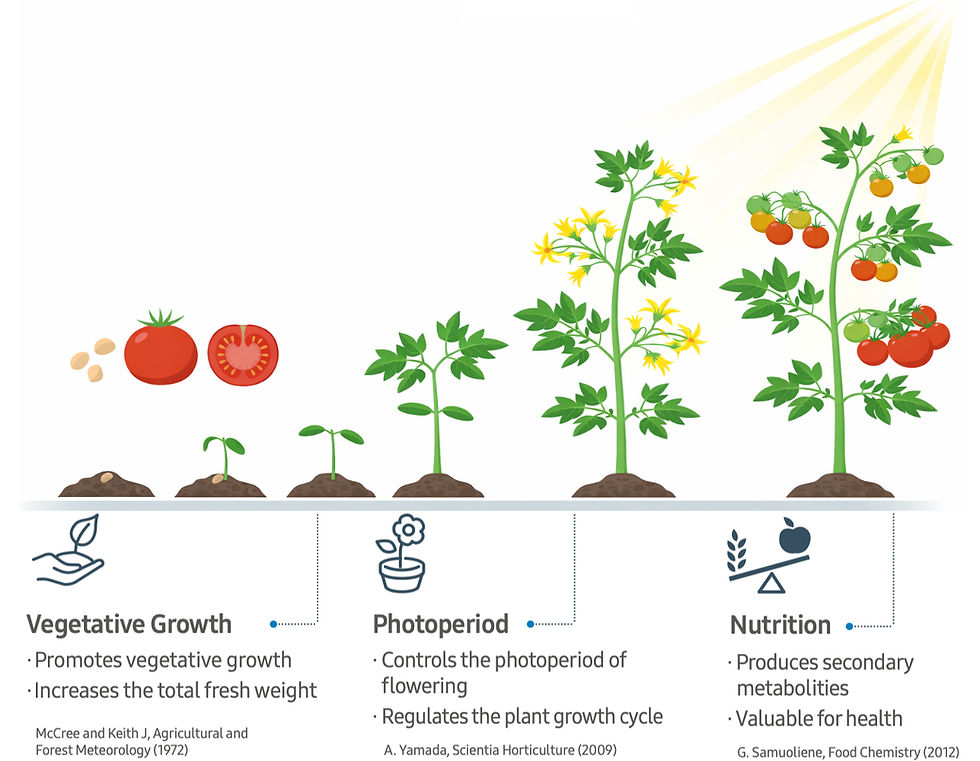
These physiological responses influence plant morphology and growth patterns in several ways:
regulating stem elongation and plant structure
controlling flowering cycles and reproductive development
influencing pigment production and nutritional compounds
Because plants respond differently to various wavelengths, the light spectrum for plant growth has become one of the most important design parameters in modern horticulture lighting systems.
In practical greenhouse installations, growers often find that the correct combination of spectrum and intensity produces better results than simply increasing light output. This is one of the reasons LED technology has become so valuable in controlled agriculture.
Why LEDs are transforming grow lights

For decades, greenhouse growers relied primarily on high-pressure sodium lamps (HPS) for supplemental lighting. While these systems provided adequate light intensity, they also produced significant heat and offered limited spectral flexibility.
LED grow lights offer several advantages from HPS lamps that make them ideal for horticulture lighting applications.
Higher Energy Efficiency
Lighting efficiency in horticulture is typically measured using photosynthetic photon efficacy, expressed in micromoles per joule (µmol/J). This metric indicates how efficiently a lighting system converts electrical energy into photons that plants can use for photosynthesis.
Modern LED horticulture lighting systems can achieve photon efficacies between approximately 2.5 and 3.5 µmol/J, making them significantly more efficient than traditional high-pressure sodium lamps, which typically operate around 1.6–1.7 µmol/J.
Higher efficiency means growers can deliver the same amount of usable light while consuming less electricity, which is a major advantage for large-scale greenhouse operations.
Long Operational Lifetime
LED lighting systems are also known for their long lifetimes. Because LEDs are solid-state devices without fragile filaments or gas discharge components, they can operate reliably for many years.
Typical horticulture LED systems can reach 60,000 hours of operation, with light output gradually decreasing over time. Lifetime is often defined using lumen maintenance metrics such as:
L70 – when light output has declined to 70% of its initial value
L80 – when 80% of original light output remains
L90 – when 90% of initial output remains
In well-designed lighting systems with proper thermal management, these lifetimes can go beyond 100,000 hours, making LEDs extremely cost-effective for long-term greenhouse installations.
Precise Spectrum Control
One of the most important advantages of LEDs is their ability to produce specific wavelengths of light. Unlike traditional lamps, which emit broad and uncontrolled spectra, LED systems can be engineered to deliver targeted spectral combinations that support plant growth.
This capability allows growers to design lighting systems that optimize plant responses such as photosynthesis, flowering, and morphological development.
Understanding the plant light spectrum

Plants primarily respond to light within the photosynthetically active radiation (PAR) range, which spans wavelengths from approximately 400 to 700 nanometers. Within this range, several regions of the spectrum play important roles in plant physiology.
Red Light
Red wavelengths around 630–660 nm correspond closely with the absorption peaks of chlorophyll pigments. Because of this, red light is one of the most efficient drivers of photosynthesis. It supports energy production within plant cells and plays an important role in flowering and fruit development.
Blue Light
Blue wavelengths between 430–470 nm influence plant morphology and developmental processes. Blue light contributes to healthy leaf development, compact plant growth, and regulation of stomatal activity.
Green Light
Although green light is absorbed less strongly by chlorophyll, it penetrates deeper into plant canopies than red or blue light. This allows green wavelengths to reach lower leaves and branches, improving overall canopy photosynthesis.
Far-Red Light
Far-red wavelengths around 730 nm interact with plant photoreceptors known as phytochromes. These receptors regulate flowering responses and plant height. Adjusting the ratio of red to far-red light can influence plant architecture and flowering behavior.
In many horticulture applications, combining multiple wavelengths produces better results than using only two narrow spectral bands. Research has shown that full-spectrum lighting can produce healthier plant structures and improved yields compared with simple red-blue combinations.
Key lighting metrics for LED grow lights for plants
To design effective horticulture lighting systems, growers and lighting engineers rely on several quantitative metrics.
Photosynthetic Photon Flux Density (PPFD)
PPFD measures the number of photosynthetically active photons reaching a square meter of plant canopy every second. It is expressed in µmol/m²/s and indicates how much usable light plants receive for photosynthesis.
For example, certain crops such as strawberries may require PPFD levels between 800 and 1200 µmol/m²/s to achieve optimal growth under supplemental lighting.
Daily Light Integral (DLI)
Daily Light Integral represents the total amount of photosynthetically active radiation delivered to plants over a 24-hour period. Different crops require different DLI values depending on their growth characteristics.
Photon Efficacy
Photon efficacy measures how efficiently a lighting system converts electrical energy into usable photons for plant growth. Higher photon efficacy reduces energy consumption and improves the sustainability of horticulture operations.
Applications of LED lighting in modern horticulture

LED lighting systems are now widely used across many forms of controlled agriculture.
In greenhouse cultivation, LEDs are typically used as supplemental lighting systems that extend daylight hours during winter months or provide additional illumination during cloudy weather. Supplemental lighting helps maintain consistent crop growth throughout the year.
In vertical farming, LED lighting often serves as the primary light source. Vertical farms rely on stacked cultivation layers where plants grow under artificial lighting systems. Because LEDs produce minimal radiant heat and can be installed close to plant canopies, they are ideal for these high-density growing environments.
Light-emitting diodes (LEDs) are also the an artificial light source inside photobioreactors to grow photoautotrophic culture of microalgae and cyanobacteria. Photoautotrophic culture requires light and controlled LED light is useful for producing some high-value products. Compared to natural light, LED lighting allows better control of light wavelength and intensity, and the duration of the photoperiod. LED lighting eliminates the inevitable diurnal and seasonal variations of natural light.
LED lighting is also extensively used in plant research laboratories and controlled growth chambers. Researchers use programmable LED lighting systems to study plant responses to different wavelengths, intensities, and photoperiods.
Designing effective horticulture lighting systems

Developing a successful horticulture lighting system requires careful attention to several design factors. One of the most important considerations is achieving uniform light distribution across the plant canopy. Uneven lighting can lead to inconsistent crop growth and variations in plant quality.
Optical design plays a key role in achieving uniform PPFD distribution. In greenhouse applications, wide radiation patterns are often used to spread light evenly across large cultivation areas. Optical components such as specialized lenses can help improve light uniformity while reducing the number of required luminaires.
In our experience designing horticulture LED modules, uniform PPFD distribution often delivers better crop results than increasing peak intensity alone.
Thermal management is another critical design consideration. Although LEDs are highly efficient, they still generate heat that must be dissipated effectively. In high-density lighting systems, especially in vertical farming environments, thermal design is often the limiting factor for long-term system reliability.
In practical horticulture lighting projects, engineers frequently discover that uniform PPFD distribution is more important for crop consistency than simply increasing total light output. Proper system design ensures that plants receive balanced illumination throughout the cultivation area.
Custom horticulture LED Solutions from Lumistrips

At Lumistrips, we specialize in the development of custom LED modules for horticulture lighting applications. With more than two decades of experience in LED engineering, we collaborate with lighting manufacturers, greenhouse operators, and agricultural innovators to create high-performance lighting systems made in Germany.
Our horticulture LED modules can be designed with optimized spectral combinations that support efficient photosynthesis and balanced plant growth. By integrating advanced thermal management and precision optical design, we ensure that our lighting solutions deliver uniform PPFD across plant canopies while maintaining long operational lifetimes.
Through partnerships with leading LED manufacturers and optics suppliers, Lumistrips develops lighting systems that meet the demanding performance requirements of modern horticulture. Our flexible LED module platforms enable lighting manufacturers and growers to create customized lighting solutions for greenhouses, vertical farms, and plant research facilities.
Future trends in Horticulture Lighting
The rapid advancement of LED technology continues to expand the possibilities for controlled environment agriculture. Horticulture lighting systems can incorporate advanced features such as dynamic spectrum tuning, intelligent lighting controls, and integration with environmental sensors.
These technologies allow growers to adjust lighting conditions in real time based on plant growth stages and environmental conditions. By combining LED lighting with automated control systems, modern greenhouses and vertical farms are able to achieve higher productivity while minimizing energy consumption.
Advanced LED systems allow precise spectral tuning, enabling growers to optimize plant morphology, flowering, and yield depending on crop type.
As research continues to deepen our understanding of plant responses to light, LED grow lights will remain one of the most important technologies shaping the future of horticulture.
LED lighting has become a cornerstone technology for modern controlled agriculture. By enabling precise control over light spectrum, intensity, and distribution, LED grow lights allow growers to optimize plant development while improving energy efficiency and crop quality.
Compared with traditional lighting technologies, horticulture LED lighting systems provide higher efficiency, longer lifetimes, and greater spectral flexibility, making them the preferred solution for greenhouse cultivation, vertical farming, and plant research.
Frequently asked questions
What is the best light spectrum for plant growth?
The optimal light spectrum for plant growth is typically within the photosynthetically active radiation (PAR) range of 400–700 nm, where plants absorb light most efficiently. Blue light (400–500 nm) supports vegetative growth and compact morphology, while red light (600–700 nm) drives photosynthesis and flowering. In advanced horticulture lighting systems, we often combine these wavelengths with controlled amounts of green and far-red light to achieve balanced plant development and improved yield.
What is PPFD in grow lights?
PPFD (Photosynthetic Photon Flux Density) measures the number of photosynthetically active photons that reach a specific surface area per second, expressed in µmol/m²/s. It is the most relevant metric for evaluating grow lights, as it directly indicates how much usable light reaches the plant canopy. In our lighting designs, achieving uniform PPFD distribution is just as important as reaching high intensity levels, as it ensures consistent plant growth across the entire cultivation area.
Are LED grow lights better than HPS?
In most modern horticulture applications, LED grow lights outperform traditional HPS (High-Pressure Sodium) lamps. LEDs offer higher efficiency (measured in µmol/J), longer operational lifetime, lower heat output, and precise spectral control. This allows growers to optimize lighting conditions for specific crops and growth stages while reducing energy consumption and cooling requirements. As a result, LED systems are now the preferred choice for greenhouses, vertical farms, and controlled environment agriculture.
What is full spectrum LED lighting for plants?
Full spectrum LED grow lights are designed to replicate the broad spectral distribution of natural sunlight within the PAR range. Unlike narrow-band lighting, full spectrum solutions include a balanced mix of blue, green, and red wavelengths, often extended with far-red components. This approach supports natural plant development, improves visual assessment for growers, and is particularly beneficial in applications where both plant performance and human working conditions are important.
How many hours per day should grow lights be used?
The required lighting duration depends on the crop type and growth stage, but most plants require between 12 and 18 hours of light per day. Vegetative growth typically benefits from longer photoperiods, while flowering stages may require shorter cycles. In professional horticulture environments, lighting schedules are carefully controlled to optimize plant physiology and energy efficiency.
Why is PPFD more important than lumens in horticulture lighting?
Lumens measure brightness as perceived by the human eye, which is not relevant for plant growth. PPFD, on the other hand, quantifies the number of photons in the PAR range that plants can actually use for photosynthesis. This makes PPFD a far more accurate and meaningful metric for evaluating horticulture lighting systems. When designing LED solutions, we focus on maximizing usable photon delivery rather than visual brightness.
What are the advantages of custom horticulture LED modules?
Custom horticulture LED modules allow precise optimization of spectrum, intensity, form factor, and thermal performance for a specific application. At Lumistrips, we design and manufacture LED modules in Germany using high-quality components from leading manufacturers such as Nichia, Cree, and ams OSRAM. This enables us to deliver solutions with higher efficiency, longer lifetime, and better performance compared to generic off-the-shelf products.
Lumistrips supports the horticulture industry with advanced LED modules and custom lighting solutions designed for performance, reliability, and efficiency. Our expertise enables lighting manufacturers and growers to develop next-generation horticulture lighting systems tailored to the specific needs of modern crop production.
Contact Lumistrips for custom horticulture LED modules


Comments