
Green Light in Horticulture Grow Lights: Canopy Penetration & Full Spectrum LED Benefits
Updated: Apr 22
From “wasted photons” to a core driver of canopy efficiency, crop quality, and real-world performance

For much of the past two decades, horticulture lighting design followed a seemingly logical rule: deliver the wavelengths plants absorb most efficiently. Chlorophyll absorption peaks sit in the blue (~450 nm) and red (~660 nm) regions of the spectrum, while green light—spanning roughly 500–560 nm—is more likely to be reflected, which is why leaves appear green to the human eye.
The conclusion seemed obvious: green photons are wasted photons, and a tight red/blue LED recipe is the most energy-efficient way to drive plant growth.
That conclusion, while photochemically defensible at the single-leaf level, has proven inadequate for real-world crop production. Plants are not flat, isolated surfaces; they are layered, three-dimensional systems where light distribution matters as much as absorption. As commercial horticulture has scaled—and as companies like Signify, Fluence by OSRAM, and Valoya have refined their spectral strategies—the role of green light has been re-evaluated. It is no longer treated as inefficiency, but as a functional component of high-performance lighting.
The Absorption Model—and why it breaks down

At the chloroplast level, the argument against green light is real. Chlorophyll a and b absorb less efficiently in the green region, creating a trough in the absorption spectrum. But this model describes only what happens at the first interaction between light and the upper surface of a leaf.
In real growing environments, two additional constraints dominate. Upper leaf layers in high-light conditions are often enzyme-limited rather than light-limited. Once saturation is reached, additional photons—particularly in red and blue—do not increase photosynthesis proportionally.
At the same time, lower leaf layers and subcanopy foliage are almost always light-limited. These regions receive significantly less radiation and therefore contribute less to total carbon assimilation.
Green light changes this dynamic. It is more transmissive through leaf tissue than red or blue wavelengths, penetrating deeper into the mesophyll and passing into lower canopy regions. Instead of being “lost,” green photons are redistributed—reaching chloroplasts that would otherwise remain under-illuminated.
Canopy penetration: the real efficiency mechanism

In dense growing systems—vertical farms, propagation trays, or high-wire greenhouse crops—light distribution is often the limiting factor for productivity.
Red and blue photons are absorbed rapidly at the canopy surface. This creates a vertical imbalance where top leaves approach saturation while lower leaves operate below optimal photosynthetic levels.
Green light mitigates this imbalance by delivering photons deeper into the canopy. It activates photosynthesis in lower leaves, improving whole-plant efficiency rather than maximizing performance at a single point.

This is not a marginal effect. Controlled studies have shown that differences in light transmittance between red and green wavelengths can translate into measurable increases in biomass—on the order of ~15% in certain conditions. Under high-light environments, increasing green light can even drive more total canopy photosynthesis than adding more red or blue, because it reaches regions those wavelengths cannot.
Green Light as a morphological signal
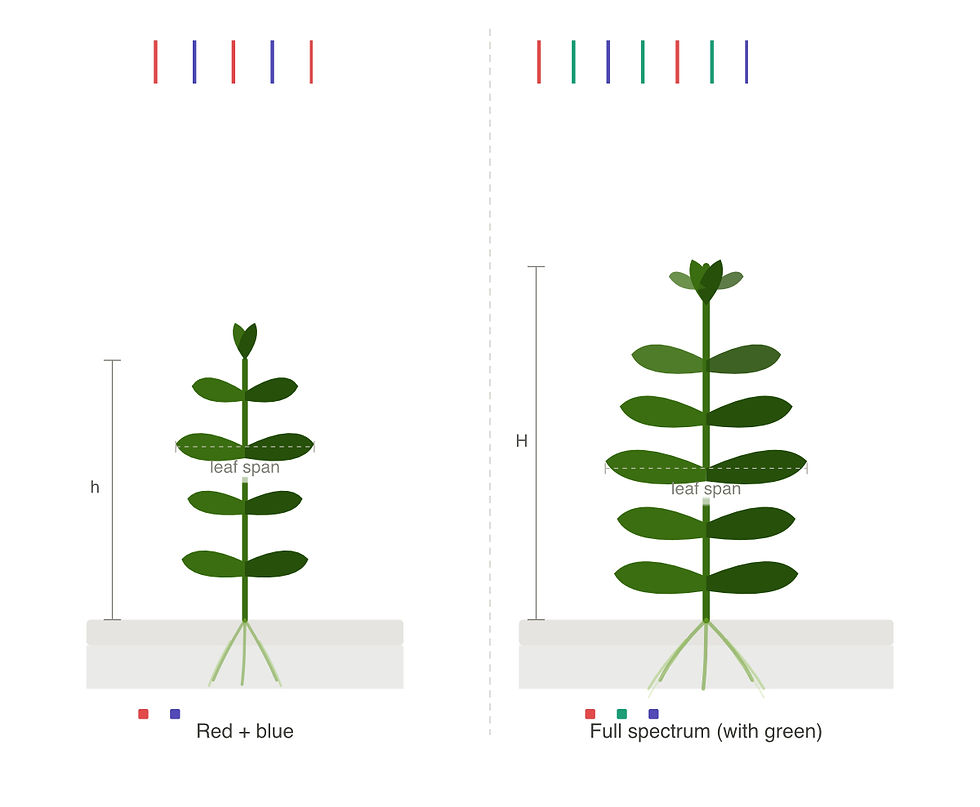
Light spectrum also determines how plants develop structurally. Blue light promotes compact growth, while red light encourages elongation. Green light interacts with these responses in a more balanced way.
When included in the spectrum, green light promotes leaf expansion and supports more effective canopy formation. This expanded leaf area improves light interception, creating a positive feedback loop where plants become better at capturing and using light over time.
Experimental data highlights the scale of this effect. In controlled strawberry propagation trials, introducing green light into a red/blue spectrum increased runner production and significantly expanded leaf area. Full-spectrum lighting delivered even larger gains in total dry mass.
These are not subtle differences—they represent structural improvements that directly influence yield potential.
Beyond yield: impact on crop quality

Modern horticulture is not driven by yield alone. Nutritional content, shelf life, and phytochemical composition are increasingly important, especially in premium produce markets.
Green light has been shown to influence these parameters. Supplemental green wavelengths can reduce nitrate accumulation in leafy greens, increase vitamin C content, and enhance chlorophyll levels. Higher chlorophyll content is often linked to improved visual quality and longer shelf life.
There is also growing evidence that green light contributes to the synthesis of specific secondary metabolites, including antioxidants and phenolic compounds. While the mechanisms are still being explored, the overall trend is clear: more complete spectra lead to better-quality crops.
The Operational Advantage: seeing the crop clearly with full spectrum LED grow lights

In controlled-environment agriculture, lighting must also serve the people managing the crop.
Red-blue lighting environments create a distorted visual field where natural color perception is lost. Under these conditions, it becomes difficult to identify early signs of nutrient deficiencies, disease, or stress.
Adding green light restores a more natural visual appearance. Plants look as they would under daylight, making it easier to detect subtle changes in color and structure. This improves crop monitoring accuracy and reduces operational risk.
Manufacturers such as Nichia, Cree or Seoul Semicondcutor have integrated this principle into horticulture-specific LED solutions or full spectrum LED grow lights, combining plant-optimized spectra with human-friendly lighting conditions.
The dose matters: Green is not unlimited
A critical nuance in spectrum design is that green light must be used in the right proportion.
Its effects follow a dose-response relationship. Moderate inclusion supports canopy penetration and balanced morphology, while excessive green light can shift plant development in less desirable ways, depending on the species.
This reinforces a fundamental principle of horticulture lighting: spectrum design is about balance, not maximization of individual wavelengths.
From Science to LED Module Design

Integrating green light into LED systems requires flexibility at the component level.
Full-spectrum white LEDs incorporate green wavelengths through phosphor conversion, delivering a continuous spectrum similar to natural sunlight. Alternatively, multi-channel systems use discrete green LEDs, allowing dynamic spectral control throughout different growth stages.

At Lumistrips, both approaches are part of how we design custom horticulture LED modules. By working with leading manufacturers such as Nichia, Cree LED, and Seoul Semiconductor, we can tailor spectral compositions to specific crops and production environments.
Our Reel-to-Reel (R2R) flex manufacturing enables these custom spectra to be produced at scale, allowing growers and OEMs to move beyond fixed lighting products toward application-specific solutions.
Designing for the Whole Plant

Green light challenges one of the oldest assumptions in horticulture lighting—that efficiency can be defined purely by chlorophyll absorption peaks.
In reality, lighting performance depends on how photons are distributed within the canopy, how plants respond structurally, and how effectively the entire system converts light into yield and quality.
Green light is not wasted. It is redistributed, repurposed, and essential for optimizing real-world plant performance.
The most advanced horticulture lighting systems are no longer built around red and blue alone. They are designed around the complexity of the plant itself—and green light is a key part of that equation.
Frequently asked questions
What does green light do for plants?
Green light penetrates deeper into plant canopies than red or blue light, reaching lower leaves that are typically light-limited. This improves whole-plant photosynthesis and supports more uniform growth.
Is green light useful for photosynthesis?
Yes. While chlorophyll absorbs green light less efficiently at the leaf surface, green photons contribute significantly at the canopy level by reaching deeper plant tissues and improving overall light-use efficiency.
Why do plants look green if they use green light?
Plants reflect a portion of green wavelengths, which is why they appear green. However, not all green light is reflected—much of it is transmitted through leaf tissue and used in deeper layers of the plant.
Are full-spectrum LED grow lights better than red-blue lights?
In most real-world growing conditions, yes. Full-spectrum LED grow lights provide a more balanced distribution of light across the canopy, improving yield, morphology, and crop quality compared to narrow red-blue systems.
How much green light should be used in grow lighting?
Green light is most effective when used in balance with other wavelengths. In many cases, a moderate proportion within a full-spectrum design delivers the best results without negatively affecting plant structure.
Does green light affect plant growth shape?
Yes. Green light influences plant morphology by promoting leaf expansion and balanced canopy development, helping plants avoid overly compact or inefficient growth patterns.
Does green light improve crop quality?
Studies show that green light can contribute to higher chlorophyll levels, increased vitamin content, and reduced nitrate accumulation in some crops, improving both visual and nutritional quality.
Why is green light important in vertical farming?
In vertical farming systems with dense canopies, green light improves light penetration and distribution, ensuring that lower plant layers receive enough light to contribute to total yield.


Comments