
PPFD practical guide for LED grow lights
A deeper, application-driven perspective for growers and lighting designers

From Measurement to Control Variable
In controlled-environment agriculture, PPFD—Photosynthetic Photon Flux Density—is often introduced as a simple metric: the number of photons within the 400–700 nm range that reach a square meter of canopy every second. But in practice, PPFD is far more than a measurement. It is one of the most powerful control variables available to growers.
What distinguishes high-performing horticulture systems from average ones is not whether PPFD is measured, but how it is interpreted and applied. The difference lies in understanding that plants do not respond to light in isolation. They respond to light as part of an integrated system that includes spectrum, canopy architecture, environmental conditions, and time.
In that sense, PPFD is not just about how much light reaches the plant. It is about how effectively that light is converted into growth, morphology, and quality.
Why LED grow lights with the same PPFD can produce Different Results
A common assumption is that if two LED grow lights can deliver the same PPFD, they will produce similar plant outcomes. In reality, this is rarely the case.
Plants do not perceive photons uniformly. The spectral composition of light determines how those photons are interpreted at the physiological level. A red-blue dominant spectrum will drive photosynthesis efficiently but may limit canopy development. A broader spectrum that includes green and far-red wavelengths can alter leaf expansion, plant architecture, and light penetration within the canopy.
This interaction becomes particularly clear in controlled studies. For example, in lettuce cultivation under artificial lighting, the addition of red and far-red light—without fundamentally changing the baseline lighting intensity—resulted in a dramatic increase in biomass and quality parameters. Fresh weight increased by over 50%, while soluble sugars and vitamin E content also showed substantial gains . The implication is direct: the same PPFD can lead to very different biological outcomes depending on how the spectrum shapes plant responses.
Example: A controlled study on lettuce:
Research shows that adding far-red light (outside the traditional PAR definition) can increase biomass—even at the same PPFD—by improving canopy light capture and leaf expansion.
Continuous red + far-red supplementation increased fresh weight by 53.76%
Soluble sugars increased by ~40%
Vitamin E increased by 34%
The Non-Linear nature of light response
Another critical aspect often overlooked in simplified explanations is that the relationship between PPFD and plant growth is not linear.
At low light levels, increases in PPFD produce strong gains in photosynthesis and biomass. As intensity rises, the rate of improvement slows. Eventually, the plant reaches a saturation point where additional photons no longer translate into proportional growth. Beyond that point, excess light can even introduce stress, particularly if other environmental parameters such as CO₂ concentration or temperature are not optimized.
This non-linear response defines the economic reality of horticulture lighting. Increasing PPFD always increases energy consumption. The key question is whether it also increases yield in a meaningful way. In many cases, especially with leafy greens, pushing PPFD beyond optimal levels results in diminishing returns.

Uniformity: the overlooked driver of yield
In practical lighting design, it is tempting to focus on achieving high PPFD values at specific measurement points. However, plants grow across entire surfaces, not at isolated points. What matters is not the peak intensity, but the consistency of light distribution across the canopy.
Uneven PPFD leads to uneven crops. Some plants receive optimal light, while others operate below their potential. The result is variability in size, morphology, and development speed, which ultimately reduces marketable yield per square meter.
This is why leading horticulture lighting systems prioritize optical design and fixture layout as much as raw output. A slightly lower but highly uniform PPFD often delivers better commercial results than a higher, poorly distributed one.

PPFD in relation to crop type
Different crops operate in fundamentally different light regimes, and understanding this is essential for applying PPFD correctly.
Leafy greens such as lettuce and herbs are relatively low-light crops. They reach their optimal photosynthetic efficiency at moderate PPFD levels, and pushing intensity too high rarely produces proportional gains. Instead, it increases energy consumption and can negatively affect morphology.
Fruiting crops like tomatoes and cucumbers operate at a higher photosynthetic capacity. They can utilize significantly higher PPFD levels, particularly when supported by CO₂ enrichment and optimized climate control. In these systems, light becomes a primary yield driver.
High-light crops, including cannabis and certain ornamentals, push this even further. Here, PPFD becomes a central parameter in maximizing output, but only within tightly controlled environments where all other growth factors are aligned.
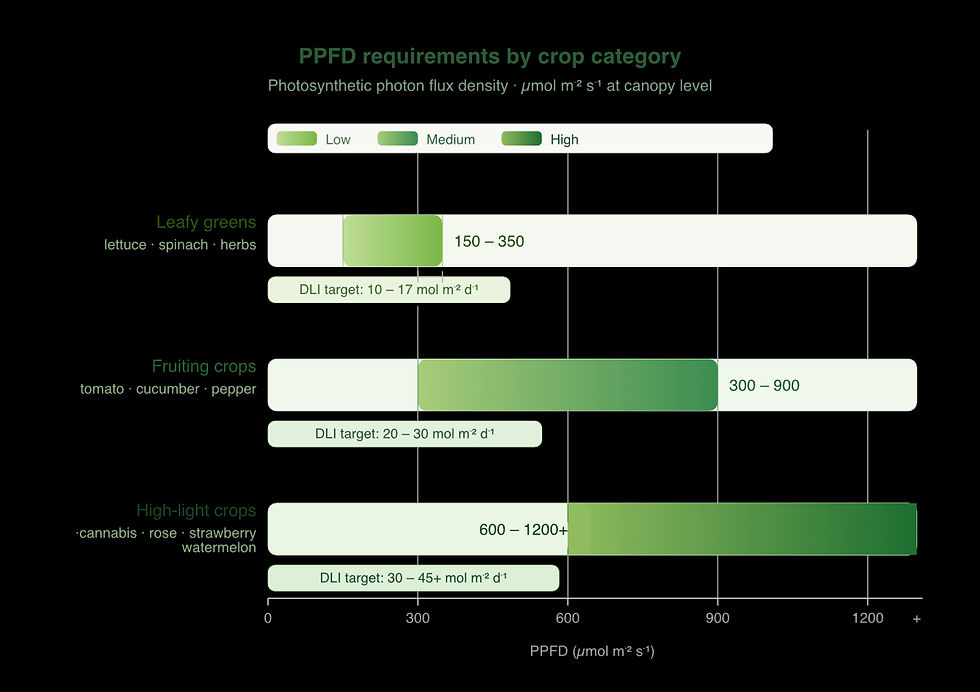
To make PPFD actionable, here are realistic operating ranges used in commercial systems:
Leafy Greens (Lettuce, Spinach, Herbs)
150–250 µmol·m⁻²·s⁻¹ → energy-efficient production
250–350 µmol·m⁻²·s⁻¹ → optimized growth
350 µmol·m⁻²·s⁻¹ → diminishing returns unless CO₂ enriched
Fruiting Crops (Tomato, Cucumber, Pepper)
300–600 µmol·m⁻²·s⁻¹ → baseline production
600–900 µmol·m⁻²·s⁻¹ → high-yield systems
900+ µmol·m⁻²·s⁻¹ → only viable with full environmental control
High-Light Crops (Cannabis, Watermelon, Some Ornamentals)
600–1000 µmol·m⁻²·s⁻¹ → standard
1000–1500 µmol·m⁻²·s⁻¹ → advanced cultivation with CO₂
Static vs Dynamic PPFD Strategies
Traditional horticulture lighting systems often apply a fixed PPFD throughout the entire growth cycle. While simple, this approach does not reflect how plants actually develop.
Young plants require relatively low light levels. At this stage, excessive PPFD can lead to unnecessary energy use and even physiological stress. As plants enter vegetative growth, their capacity to use light increases, and higher PPFD supports faster canopy development. During the finishing phase, further increases can enhance yield or specific quality traits, depending on the crop.
A dynamic lighting strategy can look this:
Seedling Stage
Low PPFD (100–200 µmol·m⁻²·s⁻¹)
Focus on morphology, not biomass
Vegetative Stage
Moderate PPFD (200–400 µmol·m⁻²·s⁻¹)
Rapid leaf expansion and canopy formation
Finishing Stage
Higher PPFD (300–600+ µmol·m⁻²·s⁻¹ depending on crop)
Maximizing yield and secondary metabolites
Advanced LED grow lights now increasingly adopt a dynamic approach, adjusting PPFD over time based on:
Growth stage
Target morphology
Energy optimization

This aligns light delivery with plant demand, improving both efficiency and crop outcomes. It also opens the door to more advanced strategies, where PPFD is coordinated with spectral changes to guide plant morphology and composition.
PPFD and the Daily Light Integral
While PPFD defines instantaneous light intensity, plants ultimately respond to the total amount of light they receive over time. This cumulative measure is known as the Daily Light Integral (DLI).
Two environments with identical PPFD can produce very different results if the photoperiod differs. Extending the duration of lighting increases the total number of photons delivered to the plant, often with greater efficiency than increasing intensity alone, for example:
300 µmol·m⁻²·s⁻¹ for 12 hours → lower DLI
300 µmol·m⁻²·s⁻¹ for 18 hours → higher DLI
For lettuce, a typical target would be:
12–17 mol·m⁻²·day⁻¹ DLI
For tomatoes:
20–30+ mol·m⁻²·day⁻¹
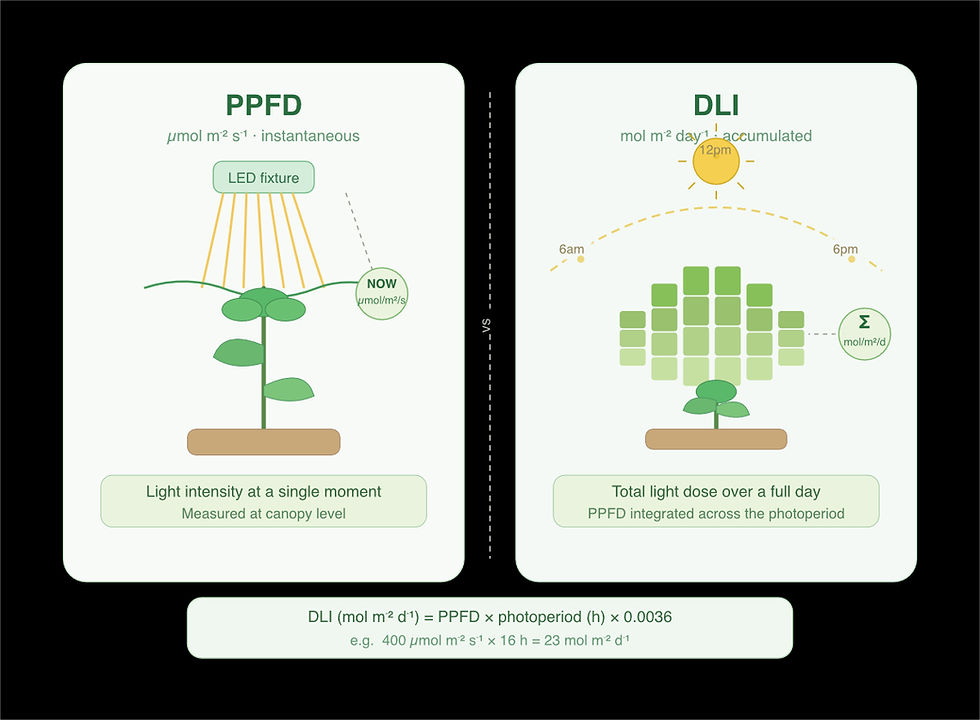
For many crops, optimizing DLI rather than maximizing PPFD provides a more energy-efficient path to higher yields. This is particularly relevant in indoor farming, where photoperiod control is unrestricted. Thus, optimizing PPFD without considering DLI is one of the most common design errors.
Canopy-Level light utilization
PPFD is typically measured at the top of the canopy, but plants are three-dimensional systems. The efficiency with which light is used depends on how deeply it penetrates into the canopy structure.

Dense canopies can create a situation where upper leaves receive more light than they can use, while lower leaves remain under-illuminated. This reduces overall photosynthetic efficiency. Spectral strategies that include green and far-red wavelengths can improve light penetration and redistribute energy within the plant.
This is one of the reasons why systems with identical PPFD can produce different biomass outcomes. It is not only the quantity of light that matters, but how it is spatially distributed within the crop.
The Energy perspective
From a system design standpoint, PPFD must always be evaluated in the context of energy efficiency. Every increase in photon flux requires additional electrical input, and the goal is not simply to maximize light, but to maximize the return on that energy investment.
The most advanced horticulture lighting systems are designed around this principle. They optimize not only for high photon efficacy, but also for how effectively those photons are used by the plant. This includes considerations such as spectral tuning, optical distribution, and thermal management.
In practical terms, the objective is not the highest PPFD, but the highest yield per unit of energy.
Lumistrips approach to PPFD Optimization
At Lumistrips, PPFD is treated as a system-level parameter rather than a fixed specification. Our LED modules are designed to deliver uniform light distribution, high photon efficacy, and flexible spectral configurations that allow growers to adapt light recipes to specific crops and growth stages.
By combining high-performance LEDs with modular system design, we enable lighting solutions that can be tailored for both intensity and spectral output. This makes it possible to move beyond static lighting setups and toward dynamic strategies that align with plant biology.
PPFD is often presented as a straightforward metric, but in modern horticulture it functions as a central element in a much more complex system. It defines the potential for photosynthesis, but its true value depends on how it interacts with spectrum, time, and plant physiology.
Understanding PPFD at this level transforms it from a number into a tool—one that can be used to shape plant growth, improve crop quality, and optimize energy use.
And ultimately, that is what defines high-performance horticulture lighting today.
Frequently asked questions
What is PPFD in horticulture lighting?
PPFD (Photosynthetic Photon Flux Density) measures the number of light photons in the PAR range (400–700 nm) that reach a square meter of plant canopy every second. It is expressed in µmol·m⁻²·s⁻¹ and represents the amount of usable light available for photosynthesis.
Why is PPFD important for plant growth?
PPFD directly determines the rate of photosynthesis. Higher PPFD generally increases plant growth up to a certain point, after which plants reach light saturation and additional light no longer improves yield significantly.
What is a good PPFD level for plants?
Optimal PPFD depends on the crop:
* Leafy greens: 150–350 µmol·m⁻²·s⁻¹
* Fruiting crops: 300–900 µmol·m⁻²·s⁻¹
* High-light crops: up to 1000+ µmol·m⁻²·s⁻¹
The correct level also depends on CO₂, temperature, and growth stage.
What is the difference between PPFD and DLI?
PPFD measures instantaneous light intensity, while DLI (Daily Light Integral) measures the total amount of light received over a full day. Plants ultimately respond to DLI, which combines PPFD with photoperiod.
Can higher PPFD damage plants?
Yes. Excessively high PPFD can lead to light stress, photoinhibition, and wasted energy. If environmental conditions are not optimized, too much light can reduce plant efficiency rather than improve it.
Does PPFD depend on light spectrum?
PPFD measures quantity, not quality. Two light sources with the same PPFD but different spectra can produce different plant responses. Spectrum influences morphology, nutrient content, and overall efficiency.
How does PPFD affect yield in vertical farming?
In vertical farming, PPFD must be carefully optimized to balance yield and energy consumption. Uniform PPFD distribution across the canopy is critical for consistent growth and maximum productivity per square meter.
Is uniform PPFD more important than high PPFD?
Yes. Uniform light distribution ensures all plants receive similar light levels, leading to consistent growth and higher overall yield. Uneven PPFD creates variability and reduces crop quality.
Should PPFD be adjusted during plant growth?
Yes. Seedlings require lower PPFD, while mature plants benefit from higher levels. Dynamic lighting strategies that adjust PPFD throughout the growth cycle improve both efficiency and plant performance.
How do you measure PPFD?
PPFD is measured using a quantum sensor (PAR meter) placed at canopy level. Measurements are typically taken across multiple points to evaluate both intensity and uniformity.

Comments