
LED Grow Lights for Lettuce Production: A Technical Guide for Greenhouses and Vertical Farms
Updated: Aug 17

Lettuce has become the flagship crop of controlled environment agriculture (CEA). Whether grown in a high-tech greenhouse in Northern Europe, a multi-layer vertical farm in Asia, or a hydroponic container farm in North America, lettuce consistently ranks among the most economically viable crops for artificial lighting systems. Its relatively low light requirement, compact growth habit, short production cycle, and high planting density make it an ideal candidate for LED-based cultivation.
Yet successful lettuce production under LEDs is not simply a matter of installing grow lights and targeting a generic PPFD value. Commercial results depend on matching light intensity, spectrum, photoperiod, fixture architecture, and environmental control to the specific lettuce type and production system. A lighting strategy optimized for a greenhouse butterhead operation may be entirely different from one designed for a stacked vertical farm producing red leaf lettuce.
This article examines the practical realities of LED lighting for lettuce production, combining scientific research with commercial horticultural practices used in modern controlled environment agriculture.
Why Lettuce is the ideal crop for controlled environment agriculture
Lettuce possesses several characteristics that make it exceptionally well suited for artificial lighting systems. The crop remains relatively short throughout its growth cycle, allowing luminaires to be mounted close to the canopy. Its growth period is typically between 25 and 45 days depending on cultivar and production method, enabling multiple harvest cycles per year. Lettuce also performs well under moderate light levels compared to fruiting crops such as tomatoes, peppers, or cucumbers, reducing electricity consumption and improving economic viability.
These characteristics explain why lettuce became one of the first crops widely adopted by commercial vertical farms. Even today, most successful indoor farming operations produce some combination of lettuce, leafy greens, herbs, and microgreens because these crops provide the best balance between yield, quality, and lighting costs.
Research has also shown that lettuce responds strongly to Daily Light Integral (DLI), making it highly predictable under artificial lighting. Unlike many fruiting crops that require substantial seasonal adjustments, lettuce can be produced year-round using carefully controlled light recipes and environmental conditions.
Lettuce types best suited for LED grow lights production

Different lettuce varieties respond differently to controlled environment cultivation.
Butterhead lettuce, including Boston Bibb and similar cultivars, remains one of the most popular greenhouse hydroponic crops. Its compact head formation, attractive appearance, and suitability for live-root packaging make it particularly valuable for commercial production.
Looseleaf varieties, including green leaf and red leaf lettuce, are perhaps the most common crops grown in vertical farms. Their rapid growth, flexibility in planting density, and ability to be harvested as either whole heads or baby leaf products provide significant operational advantages.
Romaine lettuce can also be grown successfully under LEDs, although its taller growth habit requires greater vertical clearance and more careful airflow management to prevent tip burn.
Baby leaf lettuce represents another important category. Because harvest occurs earlier than for mature heads, growers can achieve more crop cycles per year while reducing total lighting costs per harvest.
Iceberg lettuce is less common in vertical farming due to its larger size and longer crop cycle. However, research has demonstrated that iceberg lettuce can be grown successfully in vertical hydroponic systems when appropriate DLI targets are maintained.
The table below summarizes the most common lettuce categories used in commercial greenhouse and vertical farm production.
Lettuce Type | Typical CEA Use | Vertical Farm Suitability | Greenhouse Suitability | Typical Crop Cycle | |
 | Butterhead (Boston Bibb) | Premium heads, live-root lettuce | Excellent | Excellent | 30–45 days |
 | Green Leaf Lettuce | Whole-head or baby leaf | Excellent | Excellent | 25–40 days |
 | Red Leaf Lettuce | Premium salads, high-value products | Excellent | Excellent | 25–40 days |
 | Romaine Lettuce | Whole-head production | Good | Excellent | 35–50 days |
 | Baby Leaf Lettuce | Cut-and-come-again production | Excellent | Good | 15–30 days |
 | Iceberg Lettuce | Specialty indoor production | Moderate | Good | 40–60 days |
Typical controlled environment agriculture systems for Lettuce
Commercial lettuce production generally falls into three categories.
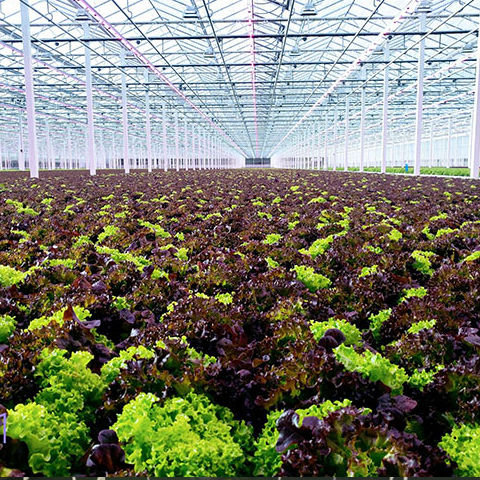
The first is the greenhouse hydroponic system, where sunlight remains the primary light source and LEDs provide supplemental lighting during winter months, cloudy periods, or low-light seasons. These facilities commonly use floating raft systems, deep water culture (DWC), or Nutrient Film Technique (NFT) channels.
The second is the fully enclosed vertical farm, where LEDs provide 100% of the crop’s light requirements. These facilities typically utilize stacked growing racks with multiple cultivation levels. Lettuce is grown under precisely controlled environmental conditions with no reliance on natural sunlight.
The third category consists of hybrid systems that combine vertical propagation areas with greenhouse finishing zones. Seedlings are started under LEDs in dense vertical racks before being transferred to greenhouse production areas where sunlight contributes to the final stages of growth.
Each system places different demands on the lighting infrastructure and influences decisions regarding fixture output, optics, waterproofing, and thermal management.
How Lettuce Is typically arranged under LED grow lights
One of the most important considerations in lettuce lighting design is the geometry of the cultivation system.
In vertical farms, lettuce is commonly grown on shelves between 600 mm and 1200 mm wide. Shelf lengths vary considerably, although modules of 600 mm, 1200 mm, 1500 mm and 2400mm are particularly common because they align well with standard LED bar lengths and rack structures.
NFT systems typically consist of long rows or channels, making linear LED bars a natural fit. Deep water culture systems use larger cultivation surfaces and often require multiple bars or wider fixtures to achieve uniform PPFD distribution.
Seedling propagation systems frequently utilize standard trays measuring approximately 300 × 600 mm or 600 × 1200 mm. These applications generally require lower light levels than finishing zones.
The table below illustrates how summarizes how modular horticulture lighting platform can be adapted for different lettuce cultivation environments.
Growing System | Typical Lighting Unit | Typical Width | Typical LED-to-Canopy Distance | |
 | Seedling Tray | Tray | 300–600 mm | 15–30 cm |
 | NFT Channel | Linear row | 100–300 mm | 20–40 cm |
 | Vertical Farm Shelf | Shelf | 600–1200 mm | 20–35 cm |
 | Deep Water Culture | Pond section | 1–10+ m | 25–50 cm |
 | Greenhouse Production | Growing bay | Several meters | 1.5–4 m |
The growing surface itself—not the fixture—should always be considered the primary design unit. Modern horticultural lighting design increasingly focuses on photons delivered per square meter of canopy rather than simply specifying fixture wattage.
Optimal distance between LEDs and Lettuce
One of the advantages of LED technology is the ability to position luminaires close to the crop.
In vertical farming systems, the distance between LEDs and the lettuce canopy is typically between 20 and 35 cm. This short distance improves optical efficiency because a higher percentage of photons reach the crop instead of being lost to surrounding structures.
For wider shelves or higher-output fixtures, mounting heights may increase to approximately 40–60 cm to improve uniformity.
Greenhouse toplighting systems operate under completely different conditions. Fixtures are often mounted between 1.5 and 4 meters above the crop, requiring substantially higher PPF output and specialized optics to achieve the desired canopy PPFD.
The optimal distance ultimately depends on fixture design, shelf width, beam distribution, and uniformity requirements rather than a single universal value.
PPFD targets for Commercial Lettuce Production
Photosynthetic Photon Flux Density (PPFD) remains the most commonly used metric for evaluating light intensity in controlled environment agriculture.
For lettuce seedlings, PPFD values between 100 and 200 µmol/m²/s are generally sufficient.
For mature lettuce production in vertical farms, most commercial facilities target between 150 and 250 µmol/m²/s. This range provides an effective balance between biomass production and electrical efficiency.
High-intensity strategies may utilize 250–300 µmol/m²/s for specific cultivars or quality objectives, particularly when producing red leaf varieties where pigmentation and anthocyanin accumulation are important.
Research has repeatedly shown that increasing light intensity beyond this range often produces diminishing returns. Additional photons increase energy consumption while generating progressively smaller yield improvements.
For greenhouse supplemental lighting, growers commonly provide 100–200 µmol/m²/s of additional PPFD, allowing natural sunlight to supply the remaining photons needed to achieve target DLI values.
Understanding DLI requirements for Lettuce
While PPFD describes instantaneous light intensity, Daily Light Integral (DLI) represents the total amount of photosynthetically active radiation received over a full day.
For lettuce production, DLI is often a better predictor of growth than PPFD alone.
Commercial lettuce production typically operates within a relatively narrow range of light intensities and daily light integrals. Most commercial lettuce production occurs within a DLI range of approximately 12–16 mol/m²/day.
Butterhead and leaf lettuce generally perform well within this range, while some greenhouse operations target approximately 17 mol/m²/day when environmental conditions allow.
Research on iceberg lettuce grown under white LEDs demonstrated particularly strong performance at approximately 11.5 mol/m²/day, achieved using a PPFD of 200 µmol/m²/s over a 16-hour photoperiod. Increasing DLI further did not improve growth and actually reduced several performance metrics.

Although lettuce is the dominant crop in many controlled environment agriculture facilities, growers often cultivate a wider range of leafy greens using the same lighting infrastructure.
The values below summarize practical PPFD and DLI targets commonly used in commercial greenhouse and vertical farm production.
Crop | Target PPFD (µmol/m²/s) | Target DLI (mol/m²/day) | Typical Photoperiod | |
 | Arugula | 150–300 | 12–18 | 14–18 h |
| Butter Lettuce | 150–250 | 12–17 | 16–18 h |
| Green Leaf Lettuce | 150–250 | 12–16 | 16–18 h |
 | Chard | 200–350 | 16–22 | 16–18 h |
 | Endive | 150–250 | 12–16 | 16–18 h |
 | Escarole | 150–250 | 12–16 | 16–18 h |
 | Green Cabbage | 250–400 | 18–24 | 16–18 h |
| Iceberg Lettuce | 150–250 | 11–15 | 16 h |
 | Kale | 200–350 | 16–22 | 16–18 h |
 | Red Cabbage | 250–400 | 18–24 | 16–18 h |
| Red Leaf Lettuce | 200–300 | 14–18 | 16–20 h |
| Romaine Lettuce | 200–300 | 14–18 | 16–18 h |
 | Savoy Cabbage | 250–400 | 18–24 | 16–18 h |
 | Spinach | 200–300 | 14–20 | 14–18 h |
This illustrates an important principle in horticultural lighting: more light is not always better. The objective is to identify the optimum DLI that maximizes crop performance while minimizing electricity consumption.
Spectrum selection: Full Spectrum vs Red-Blue Lighting
The horticulture industry has evolved considerably over the last decade.
Early vertical farms often relied heavily on red-blue LED fixtures because chlorophyll absorbs strongly in these wavelength regions and the fixtures offered excellent photon efficacy. However, commercial experience revealed several limitations. Crop inspection became difficult under purple lighting, workers disliked the visual environment, and plant morphology was not always optimal.
Today, most commercial lettuce operations have moved toward white-based full-spectrum lighting.
Modern full-spectrum LEDs provide blue, green, and red wavelengths in a balanced distribution that more closely resembles sunlight. White light also improves visual inspection, making it easier to identify nutrient deficiencies, diseases, and physiological disorders.
Many leading horticultural lighting manufacturers now utilize a white-dominant approach with modest additions of deep red and optional far-red.
For a typical lettuce lighting system, approximately 85–90% of total PPF may originate from white LEDs, while supplemental 660 nm red contributes an additional 5–10%. Some systems include a small amount of dedicated blue light for morphology control and red pigmentation enhancement.
Far-red is increasingly used as a controllable channel rather than a permanent component of the spectrum. This allows growers to influence leaf expansion and morphology without continuously altering plant architecture.
To summarize, most commercial lettuce operations have transitioned from pure red-blue lighting toward white-dominant full-spectrum strategies with targeted supplemental wavelengths:
Spectrum Strategy | Typical Use | Advantages |
White Full Spectrum | General lettuce production | Natural appearance, easy crop inspection |
White + Deep Red | Commercial lettuce farms | Improved efficacy and biomass production |
White + Red + Blue | Premium quality lettuce | Enhanced morphology and pigmentation control |
White + Red + Far-Red | Advanced recipe systems | Dynamic control of plant architecture |
Red-Blue Only | Limited modern use | Maximum efficacy but poor visual quality |
The result is a lighting strategy that combines the visual benefits of full-spectrum light with the efficiency advantages of targeted spectral supplementation.
Nichia Hortisolis™ for optimim Lettuce production
Among full-spectrum horticultural LEDs, Nichia Hortisolis™ has attracted significant attention for leafy green and lettuce production because its spectral distribution closely resembles natural sunlight while maintaining high photosynthetic performance. Unlike conventional white LEDs that often contain spectral gaps, Hortisolis provides a smooth and balanced spectrum across the PAR range, including a higher proportion of cyan and deep-red wavelengths.
For lettuce growers, this can improve crop appearance, facilitate visual inspection, and support more natural plant morphology compared to narrow-band red-blue lighting systems.
Waterproofing requirements for Lettuce LED Grow Lights
Ingress protection is often overlooked during fixture selection, yet it can significantly affect both performance and cost.
The ideal protection level depends entirely on the production environment.
Research chambers, propagation racks, vertical farms and dry indoor systems may operate successfully with open LED modules or minimally protected fixtures. In these applications, maximum thermal performance and optical efficiency are often more important than high ingress protection ratings.
Some vertical farms fall into an intermediate category where fixtures are exposed to elevated humidity but not direct water jets. In these cases, covered aluminum-profile luminaires provide a practical compromise between protection and performance.
Greenhouses, hydroponic production areas, and facilities using washdown sanitation procedures typically require IP65 or IP66-rated luminaires. These environments expose fixtures to condensation, nutrient splashes, cleaning chemicals, and high humidity levels.
Grow light type | Protection Level | Typical Application | Advantages |
LED Strip/Module | IP20 | Vertical farms, Research racks, OEM integration, dry indoor farms | Highest efficacy, lowest cost, best thermal performance |
LED Strip/Module inside covered Aluminium Profile | IP40–IP54 | Vertical farms with high humidity, propagation racks, educational systems | Improved protection with minimal optical loss |
LED Strip/Module with waterproof protection via cover or fixture case | IP65–IP66 | Greenhouses, hydroponics, commercial vertical farms | Maximum durability and cleanability |
As the above table shows, because lettuce production environments vary significantly, a single luminaire design rarely fits every application.
A LED Strip/Module is ideal for research facilities, OEM integrations, dry vertical farms, and applications where maximum efficacy and thermal performance are the highest priorities. These systems typically consist of LED modules mounted directly to aluminum profiles without protective covers.
A Covered Aluminium Profile version expands the application range substantially. By adding a clear protective cover and end caps, the luminaire becomes suitable for propagation racks, educational systems, indoor vertical farms, and other moderately humid environments. The cover also improves cleanability and protects the LEDs from accidental damage.
A IP65/IP66 Version is the preferred solution for commercial hydroponics, greenhouse cultivation, and professional vertical farming operations where reliability, sanitation, and long-term durability are critical. These luminaires withstand humidity, nutrient splashes, and routine cleaning procedures while maintaining consistent performance throughout their operational life.
Designing an efficient lettuce lighting system
Successful lettuce production depends on more than simply maximizing photon output.
The most effective systems integrate appropriate PPFD, DLI, spectrum, mounting height, fixture geometry, and environmental control into a coherent cultivation strategy. Commercial experience increasingly supports the use of white-dominant full-spectrum lighting combined with moderate supplemental red and optional far-red control.
For most lettuce applications, the goal should not be the highest possible light intensity but rather the most efficient delivery of photons that contribute to crop growth and quality. This approach reduces energy consumption, improves profitability, and creates more predictable production outcomes.
As controlled environment agriculture continues to expand, lettuce will likely remain one of the most important crops for LED horticultural lighting. Understanding the interaction between light, plant physiology, and cultivation system design is therefore essential for growers seeking consistent yields, premium quality, and long-term economic success.
At Lumistrips, we develop custom horticultural LED modules and lighting solutions for greenhouse and vertical farming applications. By combining high-efficiency LEDs, optimized optical design, and application-specific engineering, we help growers deliver the right photons to the crop while maximizing performance, reliability, and return on investment.
Frequently asked questions
What is the ideal PPFD for lettuce grown under LED lights?
Most commercial lettuce production systems operate between 150 and 250 µmol/m²/s. Seedlings typically require 100–200 µmol/m²/s, while high-quality red leaf lettuce may benefit from 250–300 µmol/m²/s. Increasing PPFD beyond this range often results in diminishing returns and higher energy costs.
What DLI does lettuce need for optimal growth?
Most lettuce cultivars perform best with a Daily Light Integral (DLI) between 12 and 16 mol/m²/day. Seedlings generally require 6–10 mol/m²/day, while mature butterhead, leaf lettuce, and romaine typically require 12–18 mol/m²/day depending on cultivar and production system.
Is full-spectrum lighting better than red-blue lighting for lettuce?
Modern commercial lettuce farms increasingly use full-spectrum white LEDs such as Nichia Hortisolis, rather than traditional red-blue fixtures. Full-spectrum lighting improves crop inspection, worker comfort, and plant morphology while maintaining excellent growth performance. Many growers supplement white light with small amounts of deep red or far-red wavelengths for additional crop control.
How far should LED grow lights be placed above lettuce?
In vertical farms, LED grow lights are commonly installed 20–35 cm above the lettuce canopy. Wider shelves or higher-output fixtures may require mounting heights of 40–60 cm to improve PPFD uniformity. Greenhouse toplighting systems are typically installed much higher, often between 1.5 and 4 meters above the crop.
Which lettuce varieties are best suited for vertical farming?
Butterhead, green leaf, red leaf, and baby leaf lettuce are among the most popular crops for vertical farming. These varieties offer short production cycles, compact growth habits, high planting densities, and predictable responses to artificial lighting.
Can lettuce be grown using only LED lights?
Yes. Lettuce is one of the most successful crops for sole-source LED production. Many commercial vertical farms grow lettuce entirely under artificial lighting using carefully controlled PPFD, DLI, temperature, humidity, and nutrient management.
Do lettuce grow lights need to be waterproof?
The required ingress protection depends on the growing environment. Dry indoor propagation racks may only require basic protection, while hydroponic systems, greenhouses, and washdown environments often benefit from IP65 or IP66-rated horticulture luminaires that can withstand humidity, condensation, and cleaning procedures.
What is the best spectrum for hydroponic lettuce production?
A white-dominant full-spectrum LED with moderate red content is currently considered the most versatile solution for lettuce production. Advanced systems may include supplemental 660 nm red, 450 nm blue, or 730 nm far-red channels to fine-tune plant morphology, pigmentation, and crop quality.
Are LED bars better than panel grow lights for lettuce?
Linear LED bars are often preferred for lettuce because they match the geometry of shelves, NFT channels, and vertical farming racks. They provide excellent light distribution, simplify installation, and allow growers to achieve uniform PPFD across the cultivation area.
How much electricity do lettuce grow lights consume?
Energy consumption depends on fixture efficacy, photoperiod, and target PPFD. Modern high-efficiency horticultural LEDs can exceed 3.5 µmol/J, significantly reducing electricity costs compared to older lighting technologies while delivering the same DLI to the crop.
What is the difference between greenhouse lettuce lighting and vertical farm lettuce lighting?
Greenhouse lettuce production primarily relies on sunlight, with LEDs providing supplemental lighting when natural light is insufficient. Vertical farms use LEDs as the sole light source, making fixture efficacy, uniformity, thermal management, and spectrum optimization even more important.
Why is PPFD uniformity important for lettuce production?
Uniform PPFD ensures that every plant receives a similar amount of light. Poor uniformity can lead to uneven growth rates, inconsistent head size, differences in harvest timing, and reduced overall crop quality. This is particularly important in high-density vertical farming systems where lighting is installed close to the canopy.


Comments