
LED Lighting for Microgreens Production
Updated: Aug 17
A Technical Guide to Designing Efficient Lighting Systems for Commercial Microgreens Farms

Microgreens have become one of the fastest-growing segments of controlled-environment agriculture (CEA). Once viewed primarily as a niche product for chefs and high-end restaurants, microgreens are now widely cultivated for retail, food service, direct-to-consumer subscriptions, and functional food markets. Their high nutritional density, short production cycle, compact footprint, and excellent suitability for indoor farming make them an ideal crop for modern horticultural lighting systems.
Unlike mature leafy greens or fruiting crops, microgreens are harvested shortly after germination, typically at the cotyledon stage or after the emergence of the first true leaves. Growth cycles range from seven to twenty-one days depending on species. Because the crop remains small throughout its lifecycle, growers can exploit one of the greatest advantages of vertical farming: the ability to position LED lighting extremely close to the canopy while achieving very high photon capture efficiency.
This combination of short crop cycles, high planting density, and close-coupled lighting creates a unique set of requirements for horticultural LED systems. Designing lighting for microgreens is not simply a matter of reducing the power used for lettuce or herbs. The geometry of the growing area, the distance between the fixture and canopy, the target Daily Light Integral (DLI), the spectral composition, and the waterproofing strategy all influence crop quality, operating costs, and return on investment.
Why Microgreens are ideally suited for controlled environment agriculture
Microgreens possess several characteristics that make them exceptionally compatible with controlled-environment production.
The crops are harvested young, reducing exposure to disease pressure and shortening production cycles. Their low canopy height allows multiple cultivation layers to be stacked vertically. Most species tolerate close lighting distances, enabling very efficient photon delivery. Furthermore, many commercially valuable microgreens respond positively to carefully controlled light recipes, particularly when targeting pigmentation, antioxidant content, vitamin concentration, and flavor development.
The most commercially important microgreens grown in vertical farms and greenhouses include broccoli, kale, red cabbage, mustard, radish, arugula, pea shoots, sunflower, basil, cilantro, beet, chard, amaranth, mizuna, kohlrabi, dill, fennel, cress, and watercress.
Among these, brassica crops such as broccoli, kale, cabbage, mustard, and radish dominate commercial production due to their rapid growth, uniform germination, strong nutritional profile, and predictable harvest timing.
Typical commercial microgreens growing systems
Unlike mature lettuce or herbs that may require deep root zones or larger plant spacing, microgreens are generally cultivated in shallow trays positioned on shelves or rack systems.
Commercial operations typically use one of three production architectures.

The first is greenhouse production with supplemental LED lighting. In this configuration, sunlight provides the majority of the Daily Light Integral during bright periods while grow light LED fixtures compensate for seasonal light deficits, cloudy weather, or short winter photoperiods. Greenhouse systems are common in regions with moderate electricity costs and good solar availability.
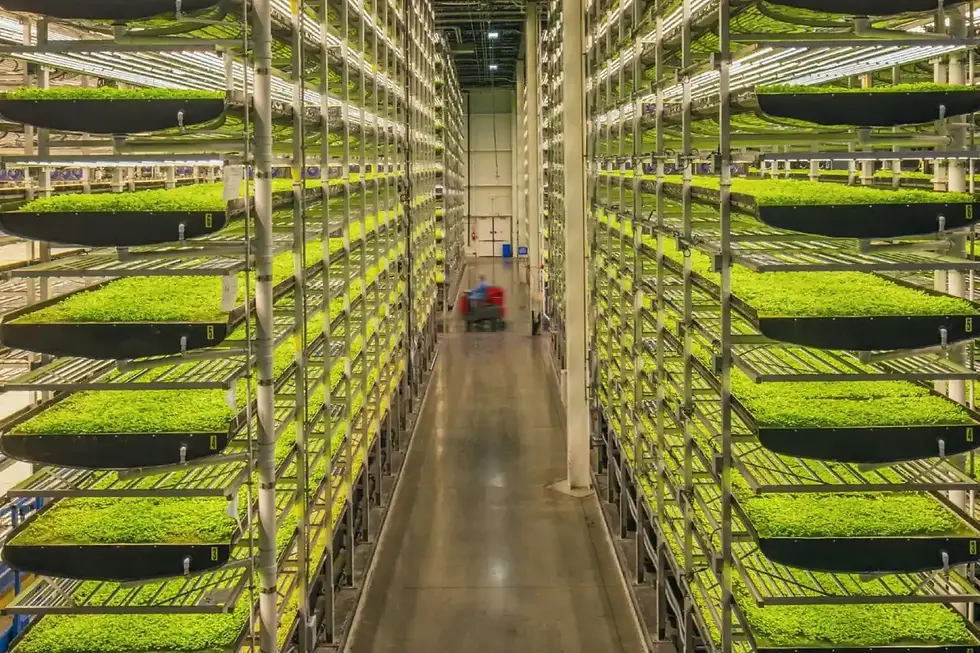
The second is the modern vertical farm. Multi-tier racks equipped with sole-source LED lighting allow complete environmental control and year-round production. Most new commercial microgreens facilities are based on this model because it maximizes production per square meter and provides consistent crop quality regardless of season.

The third is the container farm or modular indoor farm. These systems employ stacked shelves within shipping containers, converted warehouses, or insulated growing rooms. Their lighting architecture closely resembles vertical farming systems but is often optimized for smaller production volumes.
The most common cultivation formats include 10 × 20 inch (254 x 508 mm) trays in North America, 600 × 400 mm logistics trays throughout Europe, and custom shelf systems integrated into multi-layer rack structures.
Dimensions of the illuminated growing area
Understanding the geometry of the growing surface is critical when designing a lighting system.
The most common microgreens tray used in Europe measures 600 × 400 mm, corresponding to an illuminated area of 0.24 m².
Multiple trays are usually combined into shelf modules measuring:
600 × 400 mm
1200 × 400 mm
1200 × 800 mm
1800 × 800 mm
2400 × 800 mm
2400 x 1200 mm
In vertical farms, shelf widths typically range from 400 to 1200 mm, while shelf lengths may extend from 1.2 m to over 8 m.
Because microgreens are harvested before significant canopy closure occurs, achieving uniform PPFD distribution across the tray becomes particularly important. Variations in light intensity can result in differences in stem elongation, coloration, and harvest weight that become immediately visible at harvest.
Typical distance between LED fixtures and the canopy
One of the most important differences between microgreens and mature crops is the short lighting distance.
Commercial installations commonly operate with fixture-to-canopy distances between 10 and 35 cm.
At these distances, photon capture efficiency can exceed 90%, significantly higher than greenhouse toplighting systems where a substantial percentage of emitted photons never reach the crop.
A typical range is:
Growing System | Distance to Canopy |
Multi-layer vertical racks | 10–20 cm |
Shelf-based indoor farms | 15–25 cm |
Greenhouse supplemental lighting | 40–100 cm |
High-bay greenhouse toplighting | 1.5–4 m |
These short distances are one reason microgreens can be grown economically even at relatively modest fixture PPF levels.
Recommended PPFD and DLI LED lighting targets for Microgreens
Microgreens generally require lower Daily Light Integrals than mature lettuce, herbs, or fruiting crops. Nevertheless, increasing DLI within an appropriate range often improves pigmentation, nutritional quality, compactness, and harvest weight.

Although individual species exhibit different responses to light intensity, many commercial microgreens facilities standardize around 180–200 µmol/m²/s PPFD and approximately 11 mol/m²/day DLI. This range provides excellent growth across most brassica, herb, and specialty microgreens while simplifying lighting design and crop scheduling.
The table below summarizes practical starting points for commercial production under sole-source LED lighting.
Category | PPFD (µmol/m²/s) | DLI (mol/m²/day, 16 h) | Common Microgreens |
Low Light | 120–140 | 6.9–8.1 | Cress, Garden Cress, Watercress |
Medium Light | 150–190 | 8.6–10.9 | Arugula, Rocket, Beet, Chard, Carrot, Chervil, Collard, Daikon Radish, Dill, Fennel, Kohlrabi, Lemon Balm, Marigold, Mizuna, Orach, Pac Choi, Parsley, Pea Shoots, Purslane, Radish, Scallion, Shungiku, Sorrel, Sunflower, Tatsoi, Wheatgrass, Green Cabbage |
High Light | 200–250 | 11.5–14.4 | Amaranth, Red Amaranth, Basil, Cilantro, Kale, Mustard, Red Cabbage, Hon Tsai Tai, Shiso, Perilla |
These values assume approximately sixteen hours of lighting per day and represent realistic commercial production targets rather than biological maximums.
Full Spectrum vs Red-Blue Lighting for Microgreens
The earliest vertical farms frequently relied on red-blue lighting because red LEDs provided excellent photosynthetic efficiency while blue wavelengths controlled morphology.
Although this strategy remains technically valid, commercial practice has largely shifted toward broad-spectrum white lighting.
Modern full-spectrum fixtures provide several advantages.
Workers can visually inspect crops for disease, nutrient deficiencies, and contamination.
White light improves color rendering and creates a more comfortable working environment.
Broad-spectrum illumination more closely resembles natural sunlight, producing balanced plant morphology across diverse species.
Most leading horticultural lighting manufacturers now use white-spectrum architectures supplemented with specific wavelength channels such as deep red, far-red, blue, or UV-A when required.
For microgreens, the preferred strategy is generally full-spectrum white with supplemental deep red. Additional blue or UV-A may be introduced during the final days before harvest to enhance pigmentation and antioxidant production in crops such as red cabbage, kale, mustard, radish, and amaranth.
Designing the next generation of microgreens lighting
Microgreens represent one of the most efficient opportunities for controlled-environment agriculture. Their compact growth habit, short crop cycle, and compatibility with multi-layer production systems allow growers to achieve extremely high production densities while maintaining precise control over quality and yield.
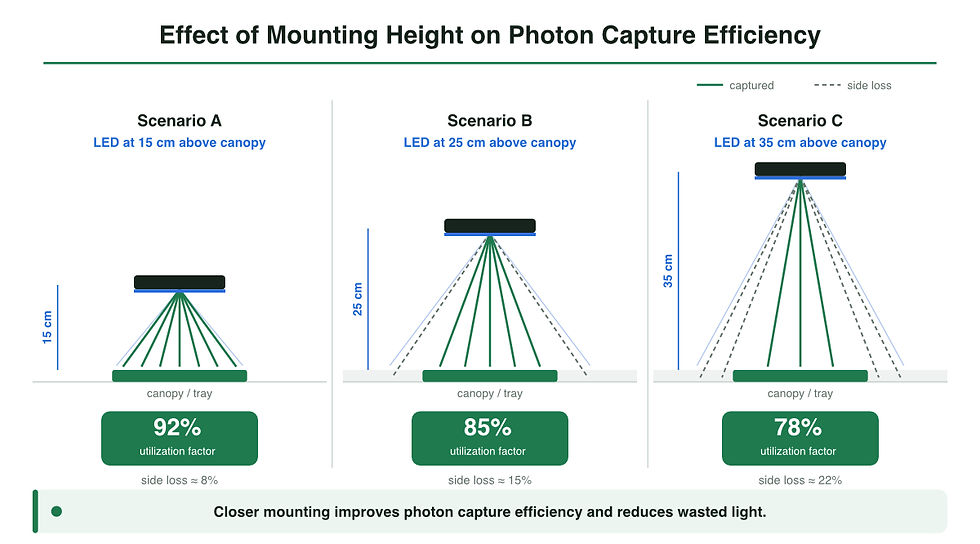
Successful lighting design requires more than simply choosing a fixture with the highest efficacy rating. Understanding PPFD, DLI, photon utilization, tray geometry, mounting height, spectrum, and environmental conditions enables growers to optimize both biological performance and operating costs.
As vertical farming continues to mature, the trend is increasingly clear. Broad-spectrum white LED systems with high uniformity, close canopy positioning, robust ingress protection, and modular form factors are becoming the preferred architecture for commercial microgreens production.
For manufacturers such as Lumistrips, the combination of a modular white-spectrum LED grow lights with, optional spectral enhancement channels, and application-specific waterproofing solutions offers a highly scalable platform capable of serving everything from research installations to industrial-scale vertical farms.
Frequently asked questions
What is the ideal PPFD for microgreens?
Most commercial microgreens grow well between 120 and 250 µmol/m²/s PPFD. Lower-light crops such as cress can perform well around 120 µmol/m²/s, while kale, mustard, red cabbage, and amaranth often benefit from 200–250 µmol/m²/s.
What DLI should microgreens receive?
Most microgreens achieve excellent growth with a Daily Light Integral between 6 and 13 mol/m²/day. A practical target for mixed-crop production is approximately 8–12 mol/m²/day.
Are full-spectrum LEDs better than red-blue grow lights for microgreens?
For most commercial operations, full-spectrum white LEDs are the preferred solution. They provide balanced plant growth, allow easier crop inspection, improve working conditions, and support consistent quality across multiple microgreens species.
How far should LED grow lights be placed above microgreens?
Commercial microgreens farms typically position LED fixtures between 10 and 35 cm above the canopy. Most vertical farming systems operate within the 15–25 cm range to maximize photon capture efficiency and improve uniformity.
How many hours of light do microgreens need per day?
Most growers use photoperiods between 14 and 18 hours per day. A 16-hour photoperiod is one of the most common commercial settings because it provides an effective balance between growth rate and energy consumption.
What are the best microgreens for vertical farming?
Broccoli, kale, mustard, radish, red cabbage, pea shoots, sunflower, arugula, mizuna, basil, cilantro, and amaranth are among the most successful crops for commercial vertical farming due to their fast growth, high market demand, and excellent response to LED lighting.
How do you calculate the PPF required for a microgreens tray?
The delivered PPF required at the crop canopy is calculated by multiplying the target PPFD by the illuminated area. For example, a 600 × 400 mm tray has an area of 0.24 m². At 200 µmol/m²/s PPFD, the crop requires approximately 48 µmol/s of delivered photons.
What spectrum is best for microgreens?
Broad-spectrum white LEDs supplemented with deep red wavelengths generally provide the best combination of growth, color, morphology, and nutritional quality. Some growers also use blue or UV-A finishing treatments to enhance pigmentation and antioxidant levels.
Do microgreens benefit from far-red light?
Far-red light can increase stem elongation and leaf expansion, but excessive amounts may reduce the compact appearance desired in many microgreens crops. For this reason, far-red is usually used selectively and in small quantities.
Why are microgreens ideal for LED lighting?
Microgreens have short growth cycles, high planting densities, and very low canopy heights. This allows LEDs to be mounted close to the crop, resulting in excellent photon capture efficiency, lower energy consumption, and highly uniform growth.
What is the advantage of a 600 × 400 mm LED grow light for microgreens?
A 600 × 400 mm LED grow light closely matches the dimensions of a standard European microgreens tray. This simplifies fixture layout, improves PPFD uniformity, reduces wasted light, and enables modular scaling for larger rack systems.
Can microgreens be grown using only artificial LED light?
Yes. Many commercial vertical farms produce microgreens entirely under sole-source LED lighting. With the correct PPFD, DLI, spectrum, temperature, humidity, and nutrient management, microgreens can be grown year-round without sunlight.
Which microgreens require the highest light levels?
Red amaranth, shiso, red cabbage, mustard, and kale typically benefit from the highest PPFD and DLI levels because increased light intensity can enhance pigmentation, anthocyanin production, and overall visual quality.


Comments