
LED Lighting for Microalgae Cultivation: How to Design Grow Lights for Photobioreactors
Updated: Aug 17

Microalgae cultivation is one of the most technically demanding applications for LED horticulture lighting. It looks simple from the outside: transparent tubes, green liquid, pumps, CO₂ and light. In practice, it is closer to optical engineering than normal crop lighting. A lettuce leaf intercepts light on a relatively flat canopy. A tomato plant receives light through a three-dimensional leaf canopy. A microalgae culture is different again: the “crop” is a moving liquid suspension where millions of cells absorb, scatter and shade each other every second.
This is why commercial lighting for microalgae cannot be designed only with a generic grow-light specification. PPFD, DLI and spectrum still matter, but they must be interpreted together with tube diameter, panel depth, culture density, mixing speed, CO₂ availability, temperature and the commercial goal of the culture. A system designed for rapid Chlorella biomass production will not use the same lighting strategy as a two-stage Haematococcus process for astaxanthin, or a hatchery system growing Isochrysis as live aquaculture feed.
For Lumistrips, microalgae is a natural extension of controlled-environment horticulture. It combines the same core lighting principles used in plant factories — PPFD, DLI, spectral control, uniformity and energy efficiency — with a different geometry. Instead of lighting trays, gutters or high-wire crops, the LED system must deliver photons into tubes, flat panels, columns, bags or biofilm surfaces. The best commercial designs are therefore not simply powerful; they are optically matched to the photobioreactor.
Why Microalgae lighting is different from normal plant lighting
In leafy greens, growers usually ask how much PPFD reaches the top of the canopy. For microalgae, that question is only the starting point. The real question is how much useful light reaches the cells throughout the illuminated volume. A dense culture can absorb much of the incoming light near the reactor wall, leaving darker zones deeper inside the liquid. If the light is too strong at the surface, cells close to the wall can experience photoinhibition while cells farther away remain light-limited. If the light is too weak, the system may be biologically stable but commercially inefficient.
This creates a design challenge. The goal is not only to produce a high PPFD reading at one point on the tube wall. The goal is to create a useful light field across the reactor geometry, with uniform light and without hotspots, while the culture is mixed fast enough to move cells through light and dark zones. In a well-designed photobioreactor, microalgae cells experience repeated short exposures to light instead of staying permanently in one optical position. This is one reason why mixing, flow rate and tube diameter are part of the lighting design, not separate topics.
For this reason, LED systems for microalgae should usually be specified by delivered PPFD at the illuminated surface, installed PPF per linear meter of tube or per square meter of reactor face, spectrum, optical distribution, waterproofing, thermal management and control strategy. A single “watts per liter” value is not enough, because a 100-liter flat-panel reactor and a 100-liter tubular loop can have completely different illuminated surface areas and optical depths.
Microalgae Species best suited for controlled-environment cultivation
The best microalgae for CEA are not always the fastest-growing strains. In commercial production, the best candidates are species where control has value. This may mean a high-value compound, a premium food-grade product, a contamination-sensitive culture, or a process where consistency matters more than the lowest possible production cost.
Microalgae or cyanobacteria | Main commercial use | Why it fits CEA | Lighting priority |
Arthrospira platensis / Spirulina | Protein biomass, phycocyanin, nutraceuticals | Robust culture, strong market demand, premium quality benefits from control | Efficient biomass production, often with red, white-red or red-blue LED recipes |
Chlorella vulgaris / Chlorella sorokiniana | Protein biomass, food supplements, cosmetics, wastewater, CO₂ capture | One of the most established controlled-culture algae | Moderate PPFD for biomass; higher or blue-enriched light for lipid or stress targets |
Haematococcus pluvialis | Natural astaxanthin | High-value crop where contamination control and stress staging are essential | Two-stage lighting: moderate growth, then high-light stress for astaxanthin |
Dunaliella salina | Natural beta-carotene | High-salinity culture reduces contamination, but controlled stress improves consistency | High light for carotenoid induction, often combined with salinity and nutrient stress |
Nannochloropsis species | Aquaculture feed, EPA-rich biomass, lipids | Important in hatcheries and omega-3 production research | Red, white-blue or red-blue lighting depending on biomass and lipid target |
Phaeodactylum tricornutum | EPA, fucoxanthin, specialty compounds | Suitable for controlled production of high-value marine compounds | Blue and white spectra are often relevant for pigment and lipid control |
Tetraselmis, Isochrysis, Pavlova, Chaetoceros | Live aquaculture feed | Hatcheries need stable, clean and predictable cultures | Moderate PPFD, stable photoperiod and reliable white or blue-enriched light |
Scenedesmus, Tetradesmus, Desmodesmus | Wastewater, feed, lipids, robust biomass | Tolerant species useful for process development and nutrient recovery | Moderate to high PPFD depending on biomass or lipid target |
For most commercial LED projects, the most important algae are Spirulina, Chlorella, Haematococcus, Dunaliella, Nannochloropsis and aquaculture-feed species. These are the groups where controlled lighting can influence productivity, product quality, process stability or the timing of stress-induced compounds.
Typical CEA Setups for Microalgae
Commercial microalgae are grown in open ponds, closed photobioreactors and hybrid systems. Open ponds can be economical for low-cost biomass, but they are exposed to contamination, weather variation and uneven light. Closed photobioreactors are more expensive, but they offer much better control of contamination, CO₂ transfer, temperature, light exposure and product consistency. This makes them the preferred option for high-value food, nutraceutical, cosmetic and aquaculture applications.
The most common controlled systems are tubular photobioreactors, flat-panel photobioreactors, airlift columns, bubble columns, bags, sleeves, thin-layer systems and biofilm reactors. Each one has a different lighting geometry. A tubular PBR needs linear or side-mounted illumination along the tube path. A flat-panel PBR behaves more like a vertical illuminated surface. A column requires radial side lighting or internal lighting to reduce dark zones. A biofilm system is closer to a plant canopy because the algae grow as a thin layer on a surface.
CEA system | Where the algae grow | Typical lighting approach | Commercial use |
Tubular photobioreactor 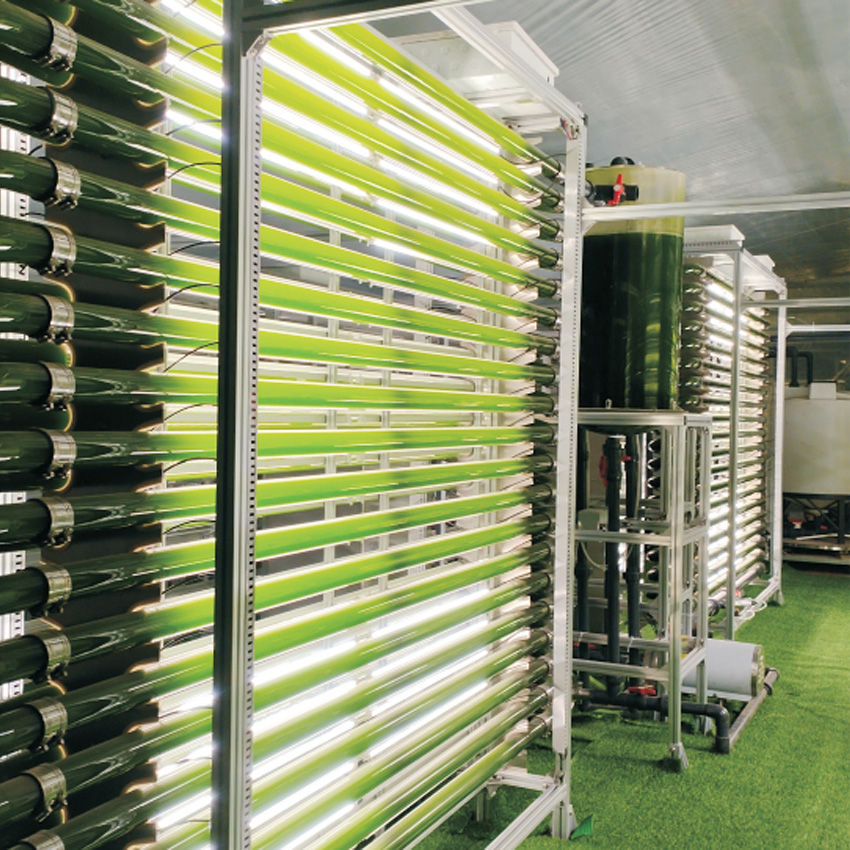 | Transparent glass or polymer tubes | Linear LED bars, strips, side modules or reflector-assisted arrays | Biomass, Chlorella, Spirulina, Nannochloropsis, inoculum, wastewater |
Flat-panel photobioreactor  | Shallow transparent panel | Rectangular LED panels on one or both sides | High surface-area-to-volume production, premium biomass, R&D scale-up |
Bubble column or airlift reactor  | Vertical transparent vessel | Side LED arrays, vertical strips or circular lighting frames | Lab, pilot, inoculum and specialty cultures |
Bag or sleeve reactor  | Flexible transparent bag | Flexible linear LEDs, side panels or greenhouse supplemental lighting | Lower-cost closed or semi-closed systems |
Thin-layer reactor  | Shallow moving liquid layer | Surface lighting, sunlight plus LED supplementation | High productivity where shallow optical path is desired |
Dimensions of photobioreactors that matter for microalgae cultivation with LED lighting
In normal horticulture, the lighting designer often starts with bench size, shelf width, crop spacing and mounting height. In LED lighting microalgae cultivation with photobioreactors, the key dimensions are tube diameter, reactor structure, panel depth, illuminated surface area and optical path length. These dimensions determine how far photons must travel through the culture and how quickly self-shading becomes a limiting factor.
For tubular photobioreactors, common tube diameters are often in the range of 20 to 100 mm. Smaller tubes improve light penetration but increase the amount of material, fittings, cleaning surface and pressure drop per liter of culture. Larger tubes hold more volume, but the inner part of the culture can become dark at higher cell densities. For compact LED-assisted systems, a practical commercial range is often around 40 to 80 mm, with 50 or 60 mm tubes being a useful starting point for calculations.
Flat-panel photobioreactors are usually described by face area and panel depth. A shallow panel of 20 to 50 mm gives a short light path and good control of light distribution, but the cost per liter is higher. Deeper panels can be more economical per liter, but they require more careful mixing and stronger or two-sided illumination. For high-density LED-lit cultures, 30 to 50 mm optical depth is often a practical starting range.
Biofilm systems are different because the algae grow on or near a surface. The illuminated area can be calculated more directly, similar to crop-canopy lighting. This makes PPFD at the biofilm surface easier to interpret than PPFD at the wall of a dense liquid reactor.
Typical distance between LED Lights and Microalgae Tubes
There is no universal LED-to-tube distance for microalgae, but there is a sequence in which the question should be asked. Tube pitch comes first, because it determines how many sides can be lit at all — a bank at 25 mm pitch has already ruled out two-sided illumination before any fixture is chosen. Published tubular work places the useful pitch at around 50 mm between adjacent absorber tubes, which balances specific growth rate against productivity per unit collector area; below 25 mm, shading between tubes costs measurable output, and above about 75 mm the additional reflector area contributes little because much of the reflected light no longer intercepts a tube.
Only once pitch and the number of illuminated aspects are fixed does the standoff distance become a free variable, and then it is set by beam angle, optical system, target PPFD, waterproofing, thermal management, cleaning access and serviceability. In compact tubular systems, linear LED bars are typically placed 20 to 100 mm from the tube. Flexible or rigid LED strips on aluminium profiles can sit closer, often 10 to 50 mm from the illuminated surface, but the design then needs excellent thermal separation and protection against moisture, condensation and cleaning chemicals.
Flat-panel photobioreactors usually allow a larger lighting distance, typically 50 to 200 mm, because the light must be spread uniformly over a rectangular face. The larger distance improves uniformity, but it also increases optical losses unless the fixture uses a diffuser, reflector or controlled beam. Column reactors are often lit from several sides at 50 to 150 mm distance to reduce the radial light gradient from the bright wall to the darker center of the vessel.
Lighting configuration | Typical LED distance | Main design concern |
Linear LED bar beside tube | 20–100 mm | Uniform tube coverage, waterproofing, thermal path |
LED strip on aluminum profile | 10–50 mm | Compact integration, heat, sealing and service access |
Rectangular LED panel beside flat PBR | 50–200 mm | Uniformity over the panel face |
LED arrays around columns | 50–150 mm | Reducing dark zones in the center of the reactor |
Biofilm reactor lighting | 50–200 mm | Uniform PPFD at the algal surface |
Internal light rods or light guides | Inside the culture volume | Photon coupling, sealing, fouling and cleaning |
Shared line between adjacent tubes | 20–50 mm | Requires ≥40–50 mm tube pitch; the most photon-efficient layout available |
The closer the LED is to the reactor, the easier it is to achieve high PPFD with low electrical power. However, close placement can create hot spots, non-uniform light, maintenance problems and heat transfer into the culture. In commercial systems, the best result usually comes from a balanced design: moderate distance, good optical control, efficient heat sinking and enough space for cleaning.
Target PPFD for commercial microalgae cultivation
Microalgae PPFD targets are much wider than those for many leafy crops. A lettuce production system may often work around 150 to 300 µmol·m⁻²·s⁻¹. Microalgae can require lower, similar or much higher values depending on the strain and production goal. In many biomass systems, a practical starting range is 100 to 250 µmol·m⁻²·s⁻¹ at the illuminated surface. For stress-induced lipids or carotenoids, the target may increase to 200 to 600 µmol·m⁻²·s⁻¹ or higher. For sensitive inoculum, live aquaculture feed or early growth stages, 50 to 150 µmol·m⁻²·s⁻¹ may be more appropriate.
It is important to avoid the common mistake of assuming that more light always means more production. At low PPFD, light limits photosynthesis. At moderate PPFD, biomass productivity increases. At excessive PPFD, cells can become photoinhibited, energy is wasted and temperature control becomes harder. In dense cultures, increasing PPFD at the wall may only create a brighter surface layer while the inner volume remains under-lit. This is why reactor geometry and mixing must be considered together with PPFD.
Microalgae group | Commercial target | Practical PPFD range | Typical lighting strategy |
Spirulina | Protein biomass, phycocyanin | 100–300 µmol·m⁻²·s⁻¹ | Efficient red, white-red or red-blue light with stable photoperiod |
Chlorella | Biomass, protein, lipids | 100–250 for biomass; 200–600 for stress or lipid phases | White + red/blue or tunable red-blue-white system |
Haematococcus | Astaxanthin | 25–80 for the green biomass stage; 400–800 for the red induction stage | Two-stage lighting on a single dimmable system with a 10:1 range, or a separate high-intensity induction zone |
Dunaliella | Beta-carotene | 100–300 for growth; 500–1500 in high-light stress systems | High-light white or sunlight plus LED spectral support |
Nannochloropsis | EPA, aquaculture, lipids | 100–300 for biomass; up to 700 for lipid research | Blue, white-blue or red-blue lighting depending on target |
Phaeodactylum | EPA, fucoxanthin, specialty compounds | 50–200 for biomass; 300–600 for stress studies | Blue, white or white plus color channels |
Aquaculture feed species | Live feed stability | 50–200 | Stable white or blue-enriched white light |
Scenedesmus / Tetradesmus | Wastewater, feed, lipids | 100–400 | Robust white, red-blue or white-red system |
PPFD targets for multiple illuminated faces
Almost every published irradiance figure for microalgae is measured as incident light on one face of a small laboratory vessel. They are single-sided numbers, and they cannot be applied per-face to a multi-sided industrial installation without recalculating the photon total.
A cylinder intercepts light on its projected area, so the photons a tube receives per metre scale with the number of illuminated aspects.
Used correctly, extra sides can improve system efficiency because holding total photon delivery constant and spreading it across more aspects lowers peak irradiance at the wall, shortens the maximum optical path from a full diameter to a radius, flattens the internal light gradient, and reduces both photoinhibition at the glass and dark volume at the centre. This is light dilution, and it is the documented route to a higher biomass yield on photons at unchanged energy cost.
For a 50 mm tube holding 1.96 litres per metre, the following three configurations are the same lighting system in energy terms and three quite different processes in biological terms:
Configuration | PPFD per face | Delivered flux per metre | Volumetric supply, 24 h |
One side | 200 µmol·m⁻²·s⁻¹ | 10.0 µmol/s | 0.44 mol/L/day |
Two sides | 100 µmol·m⁻²·s⁻¹ | 10.0 µmol/s | 0.44 mol/L/day |
Four sides | 50 µmol·m⁻²·s⁻¹ | 10.0 µmol/s | 0.44 mol/L/day |
The four-sided version will run at the highest yield on photons, because no part of the culture is either saturated or dark.
Best LED Spectrum for Microalgae
Microalgae contain chlorophylls, carotenoids, phycobiliproteins and other pigments depending on the species. This makes spectrum selection more species-specific than it is for many higher plants. Red and blue wavelengths remain important because they overlap with major photosynthetic absorption regions, but green, cyan, amber and white light can also be relevant depending on the organism and product target.
For commercial design, there are four practical spectrum strategies. The first is white full spectrum. White LEDs are easy to work under, simplify visual inspection, make contamination or color changes easier to see, and provide a broad spectral base. The second is red-blue lighting, which offers high biological activity and strong spectral control, but creates a purple working environment that can make visual inspection difficult. The third is a hybrid white + color-channel system, which is often the most practical commercial option. White provides visibility and broad coverage, while red and blue channels allow tuning for biomass, pigment or lipid targets.
The fourth is red only for use in closed enviroments such as multilayered PBRs that target high photon efficacy and strong photosynthetic absorption.
Spectrum | Best use | Commercial advantage | Main limitation |
White full spectrum | Food-grade biomass, mixed species, aquaculture feed, operator-visible systems | Good inspection light and broad pigment coverage | May be less photon-efficient than narrow red for some biomass systems |
Red 620–660 nm | Spirulina, Nannochloropsis species, Chlorella biomass, energy-efficient growth phases | High photon efficacy and strong photosynthetic absorption | May not optimize all pigments, fatty acids or stress metabolites |
Blue 440–470 nm | Nannochloropsis, lipid and pigment modulation, stress signaling | Useful for composition control in some species | Can be less efficient in µmol/J and may slow growth if overused |
Red + blue | Research, tunable biomass and biochemical experiments | Efficient and biologically active | Purple light makes human inspection harder |
White + red | Commercial biomass systems | Good visual quality with improved photon efficiency | Less flexible than full RGB or multi-channel systems |
White + red + blue | Flexible commercial PBRs | Best balance of inspection, efficiency and tuning | More electronics and control complexity |
UV-A or high-blue stress | Specialty pigment and stress-response production | Can trigger protective compounds | Risk of photodamage, worker safety issues and material aging |
For most commercial projects we recommend either a white base with separately dimmable red and blue channels or a narrow red-blue architecture.
Red and blue are chosen in crop lighting because they sit on chlorophyll absorption peaks and convert efficiently per photon. In a dense algal suspension thist advantage can be problematic as strongly absorbed wavelengths are absorbed quickly, so red and blue photons are consumed in the first few millimetres, saturating the cells at the wall while the interior of the tube stays dark. Green photons are absorbed less strongly, travel further, and distribute their energy more evenly through the volume — the same light-dilution effect that additional illuminated faces achieve mechanically, obtained instead through spectrum.
The effect is density-dependent, which is why it is easy to miss in laboratory work. At low cell density, red and blue perform better. At high density and long optical path, a spectrum containing green can produce more biomass per delivered photon, an effect reported in Chlorella vulgaris, Scenedesmus bijuga, Ettlia species and the cyanobacterium Synechococcus elongatus. For cyanobacteria the case is stronger again: phycobiliproteins absorb across roughly 550 to 650 nm, precisely the region that green-gap-avoiding LED recipes leave out, and Arthrospira platensis uses green light efficiently for this reason.
A white base also solves a practical problem that narrow spectra create. Contamination, colour shift and culture crash are all diagnosed visually in commercial production, and they are difficult to see under purple light.

The most common LED grow-light types for microalgae
The LED fixture format should follow the reactor geometry. A standard greenhouse top light is rarely the best answer for a dense photobioreactor rack. Microalgae systems usually require compact linear light, side lighting, backlighting or internal lighting.
LED light type | Best reactor match | Typical PPF range | Design notes |
Linear LED bars or Flexible LED strips | Tubular PBRs, bag reactors, column sides | 20–150 µmol/s per linear meter | The most relevant format for tube racks and compact systems |
Rectangular LED backlight panels | Flat-panel PBRs, biofilm modules | 150–600 µmol/s installed per m² for biomass; higher for stress phases | Uniformity over the illuminated face is more important than peak intensity |
High-output LED modules with optics | Larger tube arrays, reactors with more spacing | 50–300 µmol/s per module | Useful when the fixture must light multiple tubes or work at greater distance |
For many commercial tubular systems, flexible stirps or linear LED bars are the most practical starting point. They can be built in white, red, blue, red-blue or multi-channel versions, installed close to the tubes, and thermally connected to aluminum profiles or housings. For flat panels, a rectangular LED module or backlight panel is usually more appropriate because the goal is uniform illumination over a large face.
Typical PPF for Microalgae Grow Lights
In plant lighting, growers often compare fixtures by total PPF. In microalgae lighting, total PPF only becomes meaningful when the illuminated area is defined. A 300 µmol/s fixture could be oversized for a small tube, appropriate for a flat panel, or insufficient for a high-light carotenoid stress module. For this reason, microalgae lighting should be specified as PPF per linear meter for tube systems or PPF per square meter for flat panels and biofilms.
Application | Typical delivered PPFD | Illuminated unit | Delivered PPF requirement | Practical installed PPF |
Small lab or pilot tubular PBR | 50–200 | 0.05–0.5 m² illuminated area | 2.5–100 µmol/s | 10–250 µmol/s after losses |
50 mm tube, one-sided lighting | 100–300 | 1 linear meter of tube | 5–15 µmol/s delivered | 15–60 µmol/s per meter |
50 mm tube, broad circumference coverage | 100–300 | 1 linear meter of tube | 15.7–47 µmol/s delivered | 40–150 µmol/s per meter |
Flat-panel PBR biomass | 100–300 | 1 m² panel face | 100–300 µmol/s delivered | 150–600 µmol/s per m² |
Flat-panel or biofilm stress phase | 400–1000+ | 1 m² panel face | 400–1000+ µmol/s delivered | 600–2000+ µmol/s per m² |
These values are starting points for engineering, not universal biological recipes. The real installed PPF depends on optical utilization. A close-coupled linear bar with reflectors may deliver a high percentage of its photons to the tube. A panel mounted far away without optics may waste a much larger share. This is why fixture efficiency in µmol/J and optical efficiency at the reactor surface must be considered together.
How Lumistrips can support microalgae lighting projects
Microalgae lighting requires custom LED design because the reactor geometry is rarely standard. Tube diameter, tube spacing, panel depth, mounting rails, cleaning access, humidity, salt exposure and desired spectrum all influence the module design. A standard shelf grow light may produce photons, but it will not necessarily deliver them efficiently into a photobioreactor.
Lumistrips can design custom LED modules and strips for tubular PBRs, flat-panel PBRs, column reactors and biofilm systems. Depending on the application, this can include rigid LED bars on aluminum substrates, flexible reel-to-reel LED strips, waterproof encapsulated modules, white + red + blue multi-channel systems, high-efficacy red or blue LED configurations, custom lengths, special connectors and optics or diffusers for uniform light distribution.

Thermal management is especially important in close-coupled LED systems. LEDs mounted near a tube may deliver photons efficiently, but they can also transfer unwanted heat into the reactor zone. Some microalgae tolerate warm conditions, while others require tight temperature control. The LED module should therefore be designed with an aluminum thermal path, stable current operation and enough separation between electrical heat and the culture environment.
Because we work with leading LED manufacturers such as Nichia, Cree LED, ams OSRAM, Seoul Semiconductor and Lumileds, the spectrum can be designed at the LED package and module level. A Spirulina system may prioritize efficient red-rich biomass production. A Chlorella system may need white + red-blue flexibility. A Nannochloropsis system may require blue-enriched tuning. A Haematococcus system may need a two-stage solution with a moderate growth recipe and a higher-intensity induction recipe.
The best lighting system for microalgae is therefore not the most powerful light that fits near the reactor. It is the system that delivers the right photons, at the right surface, in the right spectrum, with the right uniformity and reliability, at the lowest practical energy cost.

Comments